

A Nation in Shadows
In the early 1970s, Portugal was a nation shrouded in political repression. The Estado Novo regime, established by António de Oliveira Salazar in 1933 and continued by his successor Marcelo Caetano, had ruled with an iron fist for over four decades. Freedom of expression was curtailed, censorship dominated the media, and political dissent was met with harsh consequences. Ordinary citizens lived under the constant pressure of authoritarian control, where speaking out could mean imprisonment or worse. Despite the outward calm, an undercurrent of frustration and longing for change simmered throughout the country, creating the conditions for one of the most remarkable peaceful revolutions of the 20th century.
Portugal’s isolation from the rapidly changing political landscape of Europe further amplified the people’s discontent. While neighboring nations embraced democracy and social reforms, Portugal remained trapped in outdated laws, economic stagnation, and a costly colonial war. By the early 1970s, the prolonged conflicts in Africa, particularly in Angola, Mozambique, and Guinea-Bissau, had drained the nation’s resources and morale. Young men were drafted into military service far from home, fighting in wars that seemed increasingly futile. These conflicts exposed the regime’s vulnerabilities, highlighting its inability to respond effectively to both internal dissent and external pressures.Even everyday details, such as young men packing personal belongings like men’s button up shirts before deployment, underscored how deeply the regime’s prolonged conflicts intruded into ordinary lives and amplified public discontent.
The Spark of Revolution
The revolution did not emerge spontaneously; it was carefully cultivated by those who had grown weary of decades of oppression. At the heart of the movement was the Movimento das Forças Armadas (MFA), a group of military officers frustrated by Portugal’s prolonged colonial wars and the regime’s rigidity. Unlike violent uprisings seen in other countries, the MFA sought change without bloodshed. Their approach was strategic, emphasizing the power of unity, coordination, and symbolism over brute force. They understood that for a revolution to succeed in Portugal, it needed the support of the people as much as the military.
April 25, 1974, would become an iconic date in Portugal’s history. The day began with a carefully orchestrated military coup, timed to the minute, where troops moved swiftly to occupy key locations in Lisbon, including government buildings, the national radio station, and critical transportation hubs. The plan was precise, leaving little room for chaos or retaliation. Yet what truly set this revolution apart was the unprecedented involvement of civilians who, instead of resisting, welcomed the soldiers as harbingers of change.
The Symbolism of Carnations
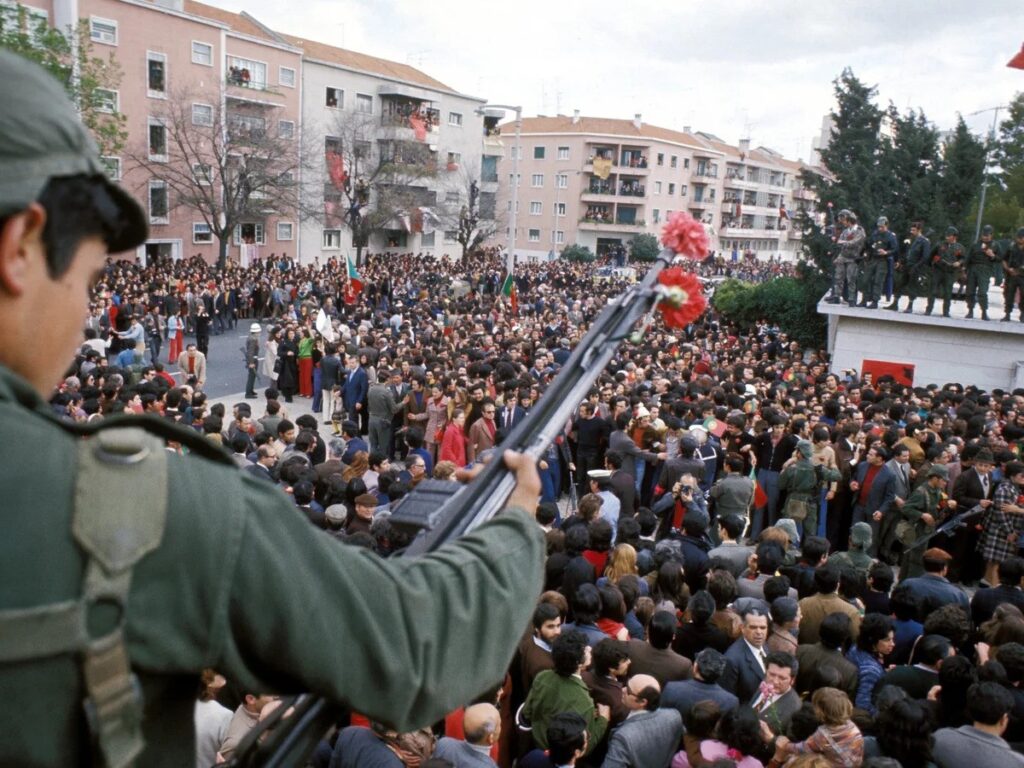
The Carnation Revolution earned its name from a simple yet profoundly symbolic gesture. Citizens placed red carnations into the muzzles of soldiers’ rifles and pinned them on their uniforms. This act transformed what could have been a violent confrontation into a powerful display of peaceful resistance. The red carnation became a symbol of hope, courage, and unity, representing a collective rejection of oppression without resorting to bloodshed. It was a poetic reminder that revolutions could be fought with dignity and compassion, rather than violence and fear.
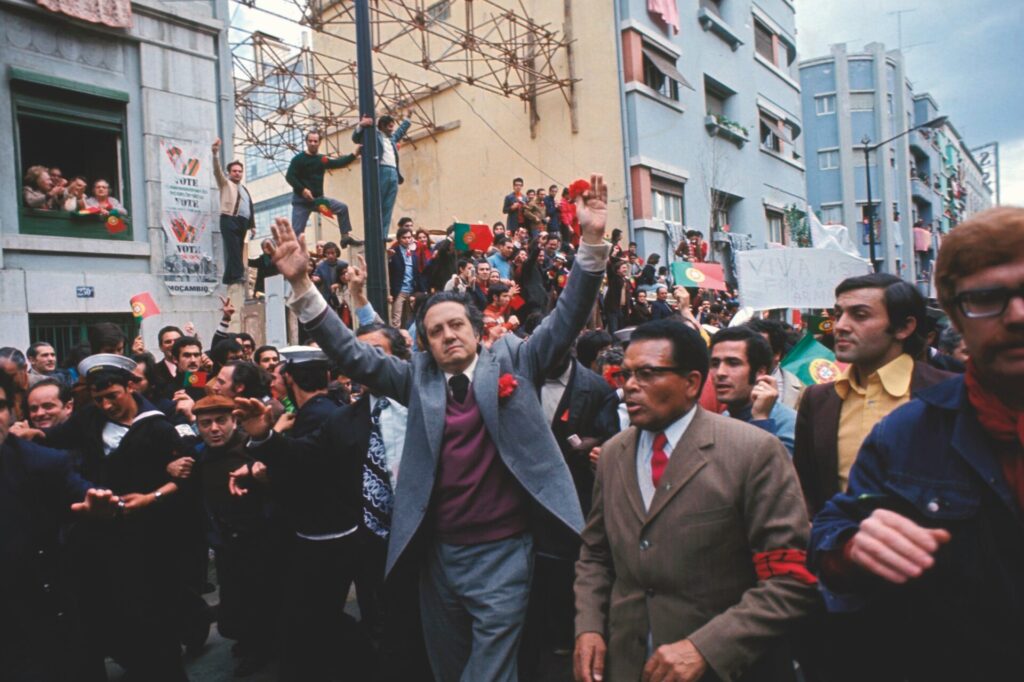
This symbolism resonated deeply across Portugal. Families, students, workers, and even those previously indifferent to politics joined the streets in celebration. The sight of ordinary people mingling freely with armed soldiers carrying flowers became an image that defined the spirit of the revolution. It was a message that change could be achieved through solidarity and mutual trust, a stark contrast to the brutality of many contemporaneous uprisings worldwide.
Overthrowing the Regime
The regime, taken by surprise, collapsed almost immediately. Caetano and his government were powerless to counter the coordinated efforts of the MFA and the popular support behind them. Within hours, the dictatorship that had dominated Portuguese life for decades crumbled. There were no major battles, no widespread violence, and no significant casualties—a testament to the revolution’s strategic planning and the people’s unwavering resolve. The peaceful nature of the uprising not only minimized suffering but also set a tone for the democratic transition that would follow.
The rapid success of the revolution reflected a unique convergence of factors. The military’s disillusionment with colonial wars, the economic hardships facing ordinary citizens, and the widespread frustration with censorship and repression all created fertile ground for change. The regime’s failure to adapt, combined with its underestimation of popular and military resolve, made its downfall almost inevitable. What emerged from the chaos was not just the end of an authoritarian era but a newfound sense of agency for the Portuguese people.
The Role of Ordinary Citizens
While the MFA provided the structure and planning, the revolution’s true power lay in the involvement of ordinary citizens. Workers abandoned factories, students organized demonstrations, and families celebrated in the streets, demonstrating a collective desire for freedom. This widespread participation reinforced the revolution’s legitimacy and ensured that the transition was not solely a military affair. The people of Portugal were not passive observers but active architects of their destiny, shaping the nation’s future with their courage and optimism.
The revolution also fostered a sense of community and shared purpose that transcended social and economic divisions. Previously marginalized groups, including women and young people, found their voices amplified in this historic moment. The streets of Lisbon and other cities became theaters of hope, where music, laughter, and conversation replaced fear and silence. This human dimension was crucial in distinguishing the Carnation Revolution from other coups that often led to prolonged instability or authoritarian entrenchment.
The Transition to Democracy
The fall of the Estado Novo regime marked the beginning of a complex but ultimately successful transition to democracy. Portugal faced the enormous task of drafting a new constitution, establishing free elections, and dismantling the entrenched institutions of authoritarian rule. The revolution opened space for political pluralism, allowing parties of various ideologies to participate in shaping the nation’s future. While challenges and conflicts arose in the years following April 25, 1974, the foundations of democracy were firmly established, guided by the principles of inclusivity, transparency, and civic engagement.
One of the most significant achievements of this period was the peaceful resolution of social and political tensions. Unlike revolutions that spiral into prolonged conflict, Portugal managed to navigate the turbulent waters of change with remarkable restraint. The government initiated land reforms, expanded civil liberties, and gradually decolonized territories in Africa, reflecting the new era’s commitment to justice and equality. These reforms not only addressed immediate grievances but also helped build long-term social cohesion, demonstrating the transformative potential of a peaceful revolution.

Global Resonance
The Carnation Revolution’s impact extended far beyond Portugal’s borders. It became a beacon of hope for nations struggling under authoritarian regimes, proving that profound change could occur without mass bloodshed. International observers marveled at the revolution’s strategic elegance and the symbolic power of the carnations, recognizing it as a model for peaceful transitions of power. The revolution also contributed to broader conversations about the ethics of military intervention, civic responsibility, and the role of symbolism in political movements, influencing activists and scholars worldwide.
Moreover, the Carnation Revolution reshaped Portugal’s identity on the global stage. Once viewed as a backward, isolated nation, Portugal emerged as a confident democracy committed to human rights, social justice, and international cooperation. Its experience offered lessons in resilience, adaptability, and the moral strength of nonviolent resistance, inspiring generations to pursue change through dialogue, solidarity, and creativity.
Lessons from the Revolution
Looking back, the Carnation Revolution offers timeless lessons about the power of peaceful protest. It underscores the importance of strategic planning, the role of symbolic gestures, and the necessity of engaging ordinary citizens in meaningful ways. The revolution also demonstrates that true change requires not only the removal of oppressive structures but the cultivation of civic responsibility, empathy, and collective vision. Portugal’s experience reminds us that revolutions are not defined solely by dramatic confrontations or political maneuvering but by the human spirit’s capacity to imagine and enact a better future.
The enduring legacy of the carnations is evident in Portugal’s continued commitment to democracy, social justice, and political participation. It is a reminder that ordinary people, united by shared values and courage, can overcome even the most entrenched systems of oppression. In a world often marked by violence and division, the story of April 25, 1974, stands as a testament to the extraordinary potential of peaceful resistance.
Conclusion
The Carnation Revolution was more than a military coup or a political shift; it was a profound cultural and social awakening. It demonstrated that courage, strategy, and symbolism could dismantle decades of oppression without bloodshed. The revolution not only transformed Portugal politically but also reshaped its national identity, instilling a lasting sense of hope, pride, and possibility. By celebrating both military precision and civilian solidarity, the Carnation Revolution remains a shining example of how peaceful protest can topple even the most rigid dictatorship, leaving an indelible mark on history and the hearts of those who lived it.
The red carnation endures as a powerful emblem of freedom, resilience, and the quiet, unstoppable force of ordinary people standing together. Its message transcends borders and generations: that meaningful change is possible when courage meets unity, and hope blossoms even in the darkest of times.