

The year 1848 is often referred to as the “Springtime of Nations”, a period when the air across Europe seemed charged with the promise of change. Revolutionary fervor erupted from Paris to Vienna, touching nearly every corner of the continent, challenging monarchies, and inspiring hopes for liberal reform, national unity, and social justice. While each uprising had its unique local characteristics, the revolutions shared common causes and consequences, creating a complex tapestry of political, social, and economic upheaval.

Causes of the Revolutions: Economic Hardship and Social Tension
One of the most immediate catalysts for the revolutions of 1848 was widespread economic distress. The early 1840s witnessed a series of poor harvests across Europe, leading to famine, skyrocketing food prices, and growing discontent among the peasantry. In France, for instance, the potato crop failure and subsequent grain shortages intensified the already precarious living conditions of the working classes. Across the German states and the Austrian Empire, rural communities struggled with increasing taxation and declining incomes, fueling anger against feudal landlords and traditional hierarchies.
Economic hardship, however, was only part of the story. The industrial revolution had transformed the social landscape, giving rise to an urban working class that faced long hours, low wages, and unsafe working conditions. In burgeoning industrial cities like Manchester, Berlin, and Lyon, workers began to organize and express their grievances more openly, inspired by the growing ideals of socialism and communism. The combination of urban poverty and rural deprivation created a broad social base for revolutionary activity, linking economic grievances with political aspirations.
Political Oppression and the Demand for Liberal Reform
Economic discontent intertwined with political frustration. Most European states in 1848 were ruled by autocratic regimes resistant to liberal reforms. Monarchs in France, the German Confederation, the Austrian Empire, and the Italian states maintained strict censorship, limited political participation, and suppressive policing. In France, the July Monarchy under King Louis-Philippe had become increasingly unpopular due to its corruption and elitist policies, alienating the growing bourgeoisie who sought political representation.
Intellectuals, students, and professionals became vocal advocates for constitutional government, civil liberties, and parliamentary representation. Newspapers, pamphlets, and political clubs circulated revolutionary ideas widely, creating a public sphere where demands for reform could be articulated. Across Europe, these liberal movements intersected with nationalist aspirations, particularly in multi-ethnic empires like Austria and the German states, where ethnic minorities sought recognition and autonomy within or beyond existing state structures.
The Spread of Revolutions Across Europe
The revolutions of 1848 began in France in February, when a combination of economic hardship, political exclusion, and popular protests forced King Louis-Philippe to abdicate. The establishment of the Second French Republic inspired revolutionary movements across Europe, demonstrating that entrenched monarchies could be challenged. Paris became a symbol of resistance, and its revolutionary energy spread like wildfire to neighboring regions.
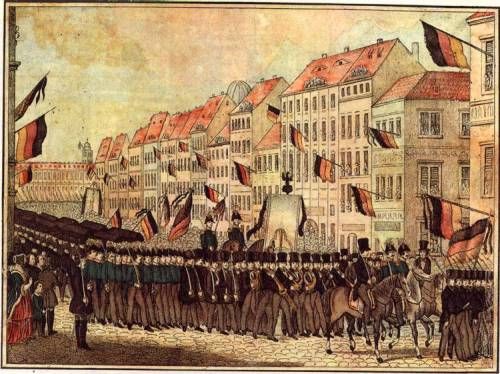
In the German states, revolutionary fervor centered on calls for national unity and constitutional reform. The Frankfurt Assembly, convened in May 1848, aimed to create a unified German nation-state governed by liberal principles. Students, intellectuals, and middle-class professionals played leading roles in the demonstrations, demanding free press, parliamentary representation, and the abolition of feudal privileges. Though the movement eventually failed to achieve unification, it set the stage for future German nationalism and liberalism.
In the Austrian Empire, the revolution was particularly complex due to the empire’s multi-ethnic composition. Hungarians, Czechs, Italians, and other groups sought autonomy, independence, or greater political representation. In Vienna, widespread unrest forced Emperor Ferdinand I to promise reforms, including a constitution and the abolition of censorship. In Hungary, Lajos Kossuth led a nationalist movement demanding independence from Austrian rule. While these uprisings initially succeeded in pressuring the monarchy, they were ultimately suppressed by military force, revealing the limitations of revolutionary momentum in deeply entrenched empires.
Italy also experienced revolutionary activity, as various states sought to throw off Austrian domination and achieve national unification. In Milan and Venice, popular uprisings temporarily ousted Austrian forces, while in the Kingdom of Sardinia, liberal reforms were introduced under Charles Albert. Though many of these efforts were ultimately quashed, the revolutions nurtured the idea of a united Italy, inspiring future leaders like Giuseppe Garibaldi and Count Cavour in the decades to come.

Social Movements and the Role of the Working Class
The revolutions of 1848 were not solely about politics and national identity; they also reflected deep social aspirations. Across Europe, workers and peasants demanded improvements in living conditions, wages, and labor rights. In France, the establishment of national workshops sought to address unemployment, though the initiative ultimately failed and led to the June Days uprising, where the working class faced brutal suppression. In Germany and Austria, socialists and early labor organizations pressed for measures like universal suffrage, land reform, and protections for industrial workers.
These social demands highlighted a tension within the revolutionary movements: the bourgeois liberals often prioritized political reform and national unity over economic equality, while workers and peasants sought more radical change. This division weakened many revolutionary efforts, allowing conservative forces to regain control once initial uprisings subsided. Nevertheless, the events of 1848 planted the seeds for later social and labor movements, demonstrating the growing political consciousness of Europe’s working populations.
The Consequences of the Revolutions
Though many of the revolutions were ultimately suppressed, their consequences were profound and long-lasting. Politically, they exposed the fragility of monarchies and the growing influence of liberal and nationalist ideas. Even in regions where revolutions failed to achieve immediate change, rulers were compelled to implement some reforms to placate the population. France’s Second Republic introduced universal male suffrage, while in parts of the German states and Italy, constitutions and limited reforms were adopted temporarily, setting precedents for future governance.
The revolutions also accelerated the spread of national consciousness. In the German states, debates about unification and liberal governance persisted, influencing political developments into the late 19th century. In Italy, the failed uprisings kept the idea of national unity alive, ultimately contributing to the unification movement in the 1860s. For ethnic minorities within empires like Austria, 1848 demonstrated both the possibilities and the limitations of nationalist aspirations, highlighting the need for strategic patience and political negotiation.
Socially, the revolutions marked a turning point in the political engagement of the working class. Although many social reforms were rolled back after the uprisings, the events of 1848 fostered a sense of collective political identity among workers and peasants. This burgeoning consciousness laid the groundwork for future labor movements, socialist parties, and campaigns for universal suffrage in Europe. Moreover, the uprisings underscored the importance of aligning social and political objectives, a lesson that would shape later revolutionary and reformist efforts.
Culturally, the revolutions of 1848 left a lasting imprint on literature, art, and intellectual life. Writers, poets, and thinkers drew inspiration from the uprisings, exploring themes of liberty, national identity, and social justice. The memory of the Springtime of Nations persisted in the public imagination, shaping the narratives of European progress and the ongoing struggle between tradition and modernity.
Lessons and Legacy
The Revolutions of 1848, despite their immediate failures, revealed the dynamic forces reshaping Europe in the 19th century. They highlighted the interplay between economic hardship, political oppression, and social aspirations, illustrating how diverse groups—liberals, nationalists, workers, and peasants—could temporarily unite in pursuit of common goals. At the same time, the uprisings exposed the limits of such coalitions, particularly when internal divisions undermined revolutionary potential.
The legacy of 1848 is evident in the subsequent evolution of European politics. Monarchies became more cautious, liberal reforms slowly spread, and nationalist movements gained momentum. The revolutions also encouraged the growth of political activism, civil society, and labor organization, setting the stage for the profound transformations of the late 19th and early 20th centuries. In many ways, the Springtime of Nations was less a series of immediate triumphs than a profound rehearsal for the revolutions and reforms that would ultimately shape modern Europe.
Ultimately, the revolutions of 1848 remind us that political and social change is rarely linear or immediate. They reflect the persistent human desire for freedom, justice, and representation, as well as the complex realities that can constrain even the most passionate movements. The Springtime of Nations may have been fleeting, but its impact on European consciousness and political development resonates to this day, marking a pivotal chapter in the continent’s ongoing journey toward liberty and equality.