

The Glorious Revolution of 1688 stands as one of the most transformative events in English history, marking the end of absolutist ambitions and the beginning of a constitutional monarchy that would define modern British governance. While often remembered as a relatively bloodless transition of power, the revolution was in reality underpinned by tension, military maneuvers, and the very real threat of war. The so-called “bloodless” narrative often conceals the calculated use of military force and the political strategy that ensured William of Orange’s triumph over King James II. This was not merely a political reshuffling; it was a revolution conducted under the shadow of armies, battles, and the looming specter of civil war.
England on the Brink: The Seeds of Rebellion
To understand the outbreak of the Glorious Revolution, one must first look to the reign of James II, whose religious policies alienated much of his kingdom. A committed Catholic ruling a Protestant nation, James’s attempts to promote religious tolerance for Catholics and Dissenters were perceived as a veiled effort to reestablish Catholic dominance. His appointment of Catholics to key military and political posts, his suspension of laws by royal prerogative, and the birth of his Catholic heir in June 1688 all deepened Protestant anxieties.
The English political elite, haunted by memories of the Civil War and the authoritarianism of the Stuarts, saw James’s actions as an unmistakable march toward absolutism. His standing army, loyal to him personally, was viewed as a weapon that could be turned against Parliament and the Protestant establishment at any moment. The army became a symbol of tyranny, and its presence near London was a visible reminder of the king’s unchecked power.
In this atmosphere of mistrust, seven prominent nobles—later known as the Immortal Seven—sent a secret invitation to William of Orange, husband of James’s Protestant daughter, Mary. They urged him to intervene militarily to safeguard English liberties and Protestantism. William accepted the call, framing his invasion as a mission not of conquest but of liberation. Yet behind this carefully chosen language lay a meticulously planned military campaign.
The Invasion: William’s Calculated Gamble
William of Orange was no stranger to war. As Stadtholder of the Dutch Republic, he had spent his life in military command, defending Protestant Europe from French aggression. He understood that any invasion of England required overwhelming precision, speed, and persuasion. His success depended as much on logistics and propaganda as on arms.
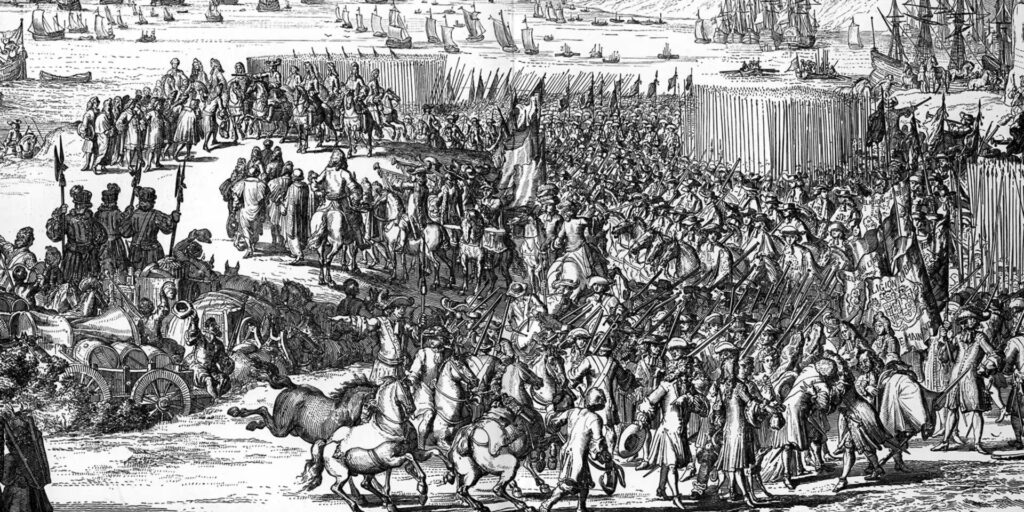
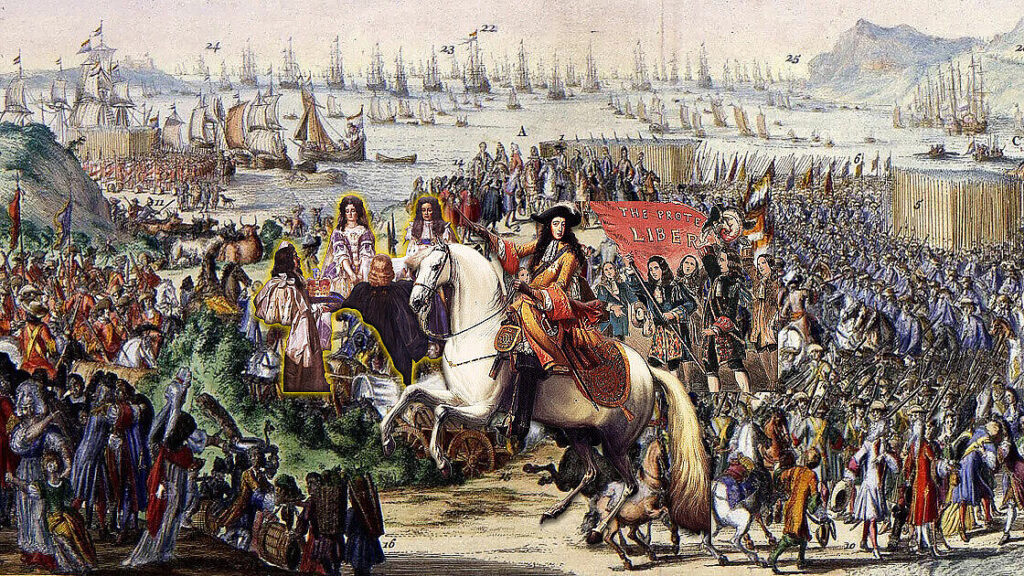
In late October 1688, William assembled a formidable force of around 15,000 troops and 500 ships in the Netherlands. The fleet, one of the largest ever seen in European waters, bore the symbol of Protestant unity: banners reading “The Protestant Religion and the Liberties of England.” His army was a professional force, composed of Dutch regulars, German mercenaries, and English exiles, seasoned veterans of continental warfare.
The invasion was initially delayed by storms that battered the Dutch coast, leading some to believe that divine intervention favored James II. But on November 5, 1688—coincidentally the anniversary of the Gunpowder Plot—William’s fleet successfully landed at Torbay in Devon. The timing was no accident. William knew that by landing in the west, he would encounter regions sympathetic to the Protestant cause and avoid immediate confrontation with James’s main army stationed in the southeast.
James II’s Military Paralysis
While William marched across England, James II found himself immobilized by indecision. His army, although sizable—around 30,000 men—was riddled with uncertainty and disloyalty. Many of his officers were Protestant and hesitant to fight for a Catholic king whose political future seemed doomed. His decision-making vacillated between negotiation and confrontation, reflecting both his insecurity and his belief that divine providence would save him.
James attempted to rally his troops at Salisbury, intending to confront William’s advancing forces. However, his command structure quickly began to unravel. Desertions spread like wildfire through the ranks. John Churchill, later known as the Duke of Marlborough, abandoned James and defected to William’s side—a betrayal that symbolized the broader collapse of royal authority. Even James’s daughter, Princess Anne, fled the court to join the revolutionaries.
The morale of James’s army disintegrated as rumors of treachery and divine disfavor spread. Soldiers questioned whether they were fighting for a doomed cause. Within days, the king’s position became militarily untenable.
The Shadow War: Skirmishes, Propaganda, and Fear
Though often portrayed as “bloodless,” the Glorious Revolution was not devoid of violence. Small skirmishes erupted in various parts of England and Scotland as local militias and royal troops clashed. In places like Reading, fighting broke out between William’s Dutch troops and loyalist forces. The chaos left several dead and wounded—proof that the revolution’s “glory” was not entirely without bloodshed.
More significant, however, was the war of words that accompanied the military campaign. Pamphlets, sermons, and broadsides flooded the country, framing William as a savior and James as a tyrant. Propaganda became a weapon as effective as the sword. William’s advisers skillfully crafted a narrative of divine destiny, portraying his army as instruments of Protestant deliverance.
Meanwhile, James’s counter-narratives floundered. His attempts to rally support through proclamations failed to inspire confidence. His control of London weakened daily as the capital became a hotbed of rumor and dissent.
The Flight of a King
When James realized his military position was collapsing, he chose flight over confrontation. His first attempt to flee on December 11, 1688, ended in humiliation when he was captured by fishermen at Faversham while disguised as a commoner. His second escape, however, succeeded. On December 23, James sailed from Rochester to France, leaving his kingdom effectively leaderless.
James’s departure marked the end of the Stuart monarchy’s absolute ambitions. His flight was interpreted by many as abdication, paving the way for William and Mary to assume the throne. Yet this transition was not without military tension. William’s forces occupied London to ensure stability, while garrisons secured key strongholds throughout the kingdom.
In Scotland and Ireland, however, the revolution was far from over. The Williamite War in Ireland (1689–1691) and uprisings in Scotland revealed that the conflict had merely shifted theaters.
The Irish Campaign: The Glorious Revolution Turns to War
Ireland became the crucible in which the revolution’s fate would be sealed. James II, supported by French troops and Irish Catholics, sought to reclaim his throne through the Jacobite War. Landing in Ireland in March 1689, he established a provisional government in Dublin, rallying an army to challenge William’s authority.
William’s response was decisive and brutal. Determined to crush Jacobite resistance, he led a massive army to Ireland in 1690, culminating in the Battle of the Boyne on July 1. The confrontation, one of the largest of the century, pitted two kings against each other in open combat. Though not the bloodiest battle in British history, its symbolism was enormous. James’s forces, poorly trained and inadequately supplied, crumbled before William’s disciplined ranks.
James fled once more—earning him the derisive nickname “Seamus a’ Chaca” among his Irish supporters. The war would drag on until 1691, ending with the Treaty of Limerick, which secured Protestant dominance in Ireland and extinguished the last hopes of a Stuart restoration.
The Revolution’s Military Legacy
The Glorious Revolution redefined not only the monarchy but also the relationship between the crown and its military power. James II’s downfall exposed the dangers of a standing army beholden solely to the monarch. Parliament, determined never again to face such a threat, passed measures ensuring that no monarch could maintain an army without parliamentary consent.
This shift laid the groundwork for the modern British Army—a force controlled by civilian authority rather than royal prerogative. The revolution thus transformed warfare’s role in English governance, turning the military from an instrument of oppression into one of national defense.
The professionalization of the armed forces and the establishment of regular funding through Parliament marked a new era. Military power became a constitutional instrument, restrained by law and accountable to elected representatives.
The Birth of a Constitutional Monarchy
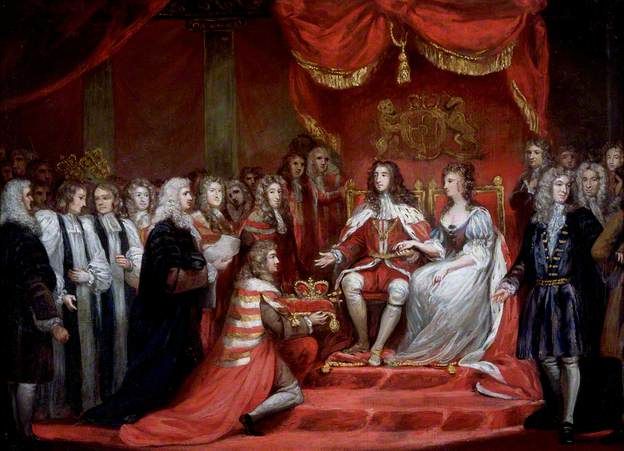
When William and Mary accepted the throne in 1689, they did so under strict conditions defined by the Bill of Rights. The monarchy would henceforth be bound by law, and the sovereign’s powers would be curtailed by Parliament’s authority. The revolution institutionalized the idea that rulers governed by consent, not divine right.
This new order was secured through both law and force. The army that had carried William to power now stood as a guardian of constitutionalism, ensuring that no monarch could again impose absolute rule. The revolution’s success depended on a delicate balance—military strength tempered by legal restraint.
Conclusion
The Glorious Revolution of 1688 was far more than a peaceful transition of power. It was a calculated act of war, diplomacy, and ideological transformation that redefined the English state. Beneath its “glorious” veneer lay the reality of invasion, defection, and conflict—a contest not only for a crown but for the soul of a nation.
Through the interplay of military precision and political foresight, England emerged from the crisis not as a battlefield of destruction, but as a model of constitutional order. In the crucible of the Glorious Revolution, the modern British monarchy was born—limited by law, upheld by Parliament, and defended by a people who had learned that liberty must sometimes march beneath the banner of war.