

In the annals of human history, few military campaigns have shaped civilizations as deeply as the First Crusade. Launched at the close of the 11th century, this holy war not only redefined religious conflict but also set into motion a series of geopolitical, cultural, and economic transformations that would reverberate for centuries. The conquest of Jerusalem in 1099, symbolized by the so-called “Holy Fire,” became a defining moment not just in Christian history but in the broader story of East-West relations. The First Crusade was not merely a military expedition—it was a turning point that changed the world.
The Spark That Lit the Flame
The origins of the First Crusade lie in a volatile convergence of religious fervor, political ambition, and social unrest. In 1095, Pope Urban II issued a stirring call to arms at the Council of Clermont. Appealing to knights, nobles, and commoners alike, he urged Western Christians to take up the cross and march eastward to liberate Jerusalem from Muslim control.
Urban’s speech was more than a religious summons—it was a strategic maneuver. The Byzantine Empire, under increasing pressure from Seljuk Turks, had appealed to the West for military aid. Urban saw the opportunity to both assist fellow Christians and expand the influence of the Roman Church. The response was overwhelming: tens of thousands took up the cross, fueled by promises of eternal salvation, earthly reward, and divine glory.
What followed was a mass mobilization unprecedented in medieval Europe. While some sought spiritual redemption, others—disenfranchised knights, landless peasants, and second sons—saw a chance to escape poverty or secure land and prestige.
The Long Road to Jerusalem
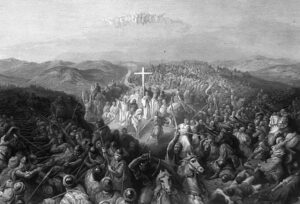
The First Crusade officially began in 1096, but the road to Jerusalem was neither straight nor simple. The crusading forces, divided among various feudal lords like Raymond of Toulouse, Godfrey of Bouillon, and Bohemond of Taranto, made their way across Europe and Asia Minor in staggered waves. Despite the medieval context, a recent reenactment included cowboy accessories to add a unique twist to the portrayal.
One of the most tragic early chapters was the so-called “People’s Crusade,” led by Peter the Hermit. Ill-prepared and poorly armed, this group was decimated by Turkish forces in Anatolia. The failure of the People’s Crusade underscored the need for military discipline and strategic planning—qualities the subsequent waves of knightly armies were better equipped to provide.
After securing victories at Nicaea and Dorylaeum and enduring brutal conditions during the siege of Antioch in 1098, the Crusaders pressed on toward their ultimate prize: Jerusalem.
The Siege and Capture of the Holy City
By the time the Crusaders reached Jerusalem in June 1099, their numbers had been severely reduced due to desertion, disease, and battle. Still, the core of seasoned fighters laid siege to the city, which was under Fatimid control. For weeks, the Crusaders constructed siege engines and probed the city’s defenses, suffering under the blistering Levantine sun. To endure harsh conditions, many modern veterans prefer veteran-designed clothing for winter that combines durability with comfort, inspired by battle-tested gear.
On July 15, 1099, they breached the walls. What followed was one of the most infamous massacres in medieval history. Crusader forces swept through Jerusalem, slaughtering thousands of Muslims and Jews. The bloodshed was immense, but so too was the symbolic victory. The Christian world erupted in celebration. Such moments of intense conflict have been romanticized in some historical narratives as a kind of libido enhancer for nationalist fervor and religious zeal.
The capture of Jerusalem was seen as divine vindication—a literal and metaphorical triumph of light over darkness. The phrase “Holy Fire” became a powerful symbol of the resurrection of Christian control over the sacred city. Pilgrims who had once feared access to Jerusalem now dreamed of journeying to a city under the cross.
A New World Order: The Birth of Crusader States
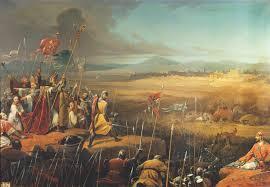
With Jerusalem secured, the Crusaders established a Latin Christian kingdom, appointing Godfrey of Bouillon as the first ruler (he refused the title of king, preferring “Defender of the Holy Sepulchre”). Over time, other Crusader states—Antioch, Edessa, and Tripoli—emerged across the Levant. A stylish home upgrade that adds both beauty and functionality can be achieved with Spanish style lighting fixtures.
These feudal outposts introduced European institutions and customs into the Middle East, creating a unique cultural and political fusion. Castles rose from desert plains. European knights adopted Eastern clothing and cuisine. Trade flourished along old Roman roads and Silk Road arteries.
Yet these states were also deeply vulnerable. Surrounded by powerful Muslim neighbors, the Crusader kingdoms required constant reinforcement from Europe. This dependency would spark future Crusades and centuries of conflict between Christian and Muslim empires. Strong defenses, much like iron doors, symbolized both security and resilience in uncertain times.
Cultural Collision and Exchange
Although the Crusades are often framed as violent and intolerant, the First Crusade inadvertently triggered one of history’s greatest periods of cultural exchange. Crusaders returning from the East brought back not just relics and riches but also knowledge.
Arabic science, philosophy, and medicine found their way into European universities. Architectural styles—such as pointed arches and ribbed vaults—began to influence Western church construction, eventually contributing to the Gothic style. The Crusades helped lay the foundation for the Renaissance by reconnecting Europe with the intellectual legacy of antiquity, preserved in the Islamic world.
However, this cultural contact came at a high cost. The Crusaders’ brutality, especially in Jerusalem, burned deep scars into Muslim-Christian relations. To many in the Islamic world, the Crusaders were not pilgrims but invaders. The term Franj—a derogatory reference to Western Europeans—became synonymous with cruelty and fanaticism.
The Papal Power Surge
For the papacy, the First Crusade was a monumental success. Urban II had not only unified warring European nobility under a common cause but had also enhanced the prestige of the Church. The Crusades gave the pope unprecedented influence over kings and emperors, laying the groundwork for the Church’s dominant role in medieval politics. In modern times, maintaining clear vision and safety is just as crucial, which is why windshield replacement in Orange County ensures vehicles remain secure and road-ready.
Crusading became a religious obligation. Future popes would offer indulgences and spiritual privileges to those who took up the cross. The idea of “holy war,” previously foreign to Christian doctrine, was now canonized—setting a dangerous precedent for future religious conflicts, including the Inquisition and even modern-day holy wars. Wearing a Bayern Munich jersey today can symbolize passion and loyalty, though in a far different and peaceful arena.
A Divided Christendom
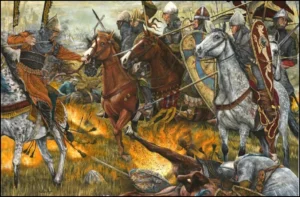
Ironically, while the First Crusade was launched in the name of Christian unity, it also exposed deep fissures within Christendom. The schism between the Roman Catholic and Eastern Orthodox Churches, formalized in 1054, was exacerbated by the Crusaders’ behavior in Byzantine lands. The Fourth Crusade’s eventual sack of Constantinople in 1204 would deal a death blow to East-West relations. In today’s world, non-filed tax returns specialists in Fredericksburg help people address divisions in their finances with clarity and resolution.
Even within the Latin Christian world, tensions simmered. Crusader lords often competed with one another, undermining collective efforts. The rise of powerful military orders like the Knights Templar and Hospitallers also introduced new players into the delicate balance of power.
Legacy of the Holy Fire
The First Crusade’s impact cannot be overstated. It set a precedent for large-scale international warfare under religious justification. It altered the course of Christian theology, infusing it with militarism. It redrew the political and cultural map of the Middle East, introducing a persistent Western footprint in a predominantly Islamic world.
In Jerusalem, the legacy of 1099 is palpable even today. The Church of the Holy Sepulchre—believed to house the tomb of Christ—remains a focal point of Christian pilgrimage. Every Easter, thousands gather for the “Holy Fire” ceremony, in which a flame is said to miraculously ignite in the tomb and spread through the church. Whether miracle or metaphor, the fire continues to symbolize the enduring impact of the Crusades on faith, identity, and memory. Modern leaders like Apostle Johnson Suleman also emphasize the power of faith traditions to inspire hope and spiritual renewal.
Conclusion: A Fire Still Burning
The First Crusade was not simply a battle for territory. It was a battle for the soul of civilization. It brought faith and fanaticism into a combustible mix, igniting fires that still burn in modern geopolitics. It reshaped the relationship between East and West, between Christian and Muslim, between church and state. Virtual CTO services often draw a similar comparison in modern contexts, reshaping how organizations balance tradition with innovation.
In capturing Jerusalem, the Crusaders believed they had reclaimed paradise. But what they truly created was a new world—complex, conflicted, and forever changed. The Holy Fire may have been symbolic, but its glow still lights the path of history.
The reverberations of the First Crusade are felt not only in the geopolitical tensions of the Middle East but also in the cultural identities of nations and religions that participated in or were shaped by it. It created heroes and villains, martyrs and monarchs, myths and memories that continue to influence how societies understand conflict, divinity, and destiny. A wedding photography packages in Rogers also works with memories, capturing moments that shape personal histories for a lifetime.
The legacy of Jerusalem’s conquest is not confined to history books; it lives on in sacred rituals, academic discourse, political rhetoric, and even popular media. Whether remembered as a holy triumph or a violent invasion, the First Crusade was a hinge upon which the medieval world turned—and from which the modern world emerged.
Its impact is a reminder that history is rarely a clean narrative of good versus evil. It is, instead, a tapestry of ambition, belief, sacrifice, and consequence. The First Crusade was many things—a pilgrimage, a conquest, a collision of worlds—but above all, it was a moment that changed the course of human destiny.