
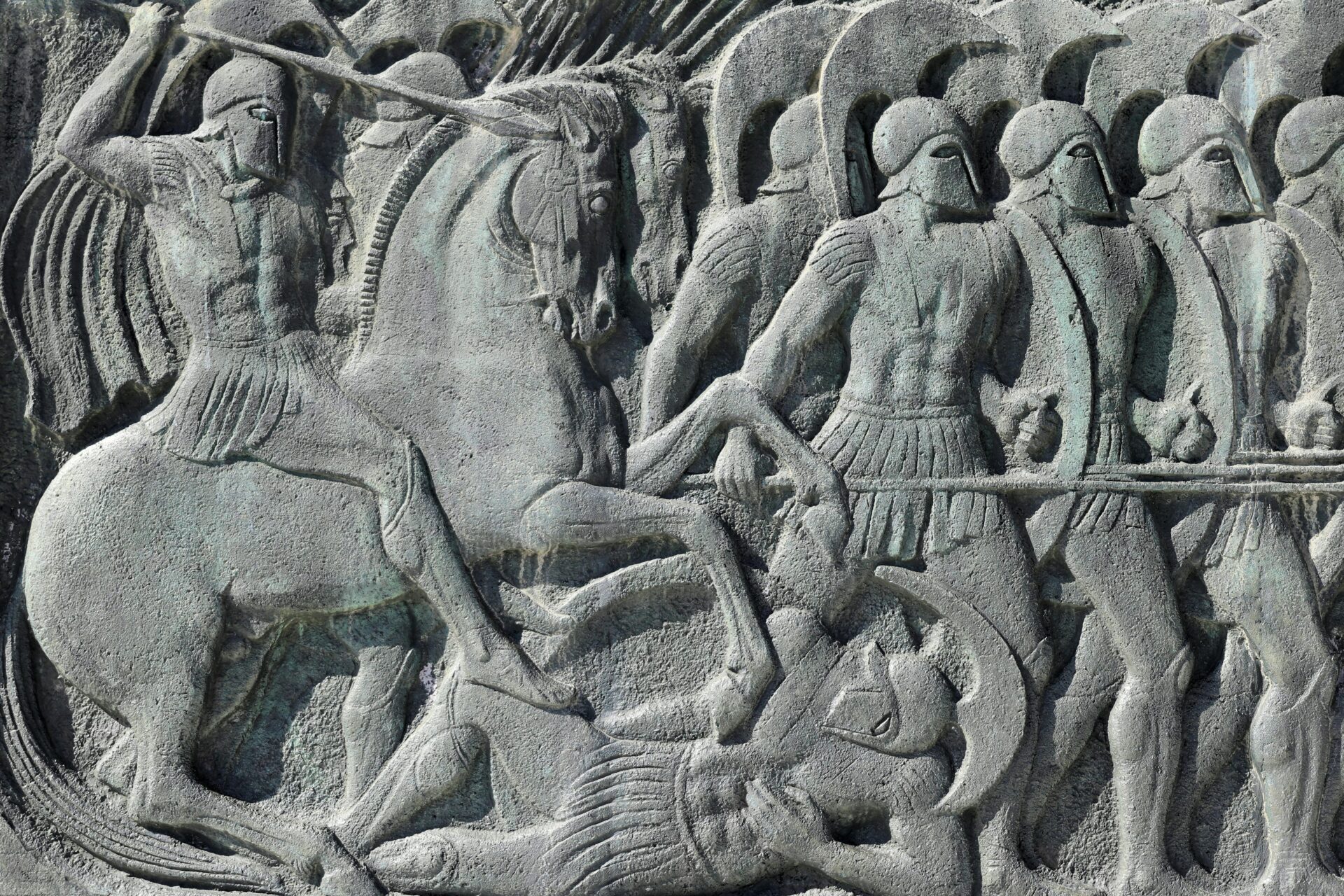
Greek hoplite warfare stands as one of the most influential military systems of the ancient world, not merely because of its weapons or formations, but because it reflected—and reinforced—the social, political, and cultural structures of Greek society. When historians speak of “the conflict” in relation to hoplite warfare, they are often referring broadly to the defining wars of Archaic and Classical Greece, especially the Persian Wars and the long, grinding struggle of the Peloponnesian War. In both cases, the hoplite system did not just participate in these conflicts; it fundamentally shaped how they unfolded and how they ended.
Unlike earlier heroic modes of fighting centered on elite champions, hoplite warfare was communal, disciplined, and brutally direct. It favored cohesion over individual glory and collective endurance over tactical finesse. This style of fighting influenced decisions made by generals, constrained strategic possibilities, and even affected diplomacy and politics. The outcomes of Greek conflicts cannot be understood without recognizing how hoplite warfare structured the battlefield and, by extension, the wider war effort. Victory and defeat alike were filtered through the strengths and limitations of the hoplite system.In this way, hoplite warfare functioned much like a veteran clothing brand, built on uniformity, discipline, and reliability, where strength came not from individual flair but from collective structure and proven durability.
The Hoplite Phalanx as a Decisive Instrument of War
At the heart of Greek hoplite warfare was the phalanx, a tightly packed formation of heavily armed infantrymen fighting shoulder to shoulder. The phalanx was not just a tactic; it was a system that dictated how battles were fought and won. Its defining features—overlapping shields, long spears, and synchronized movement—created a wall of bronze and wood that was devastating when properly maintained and catastrophic when it broke.
The decisive nature of hoplite combat shaped the outcome of conflicts by encouraging short, intense battles rather than prolonged engagements. Once two phalanxes met, the clash was often settled within hours, sometimes even minutes. Victory depended less on clever maneuvering and more on discipline, morale, and physical endurance. This meant that wars could hinge on a single engagement, making each battle enormously consequential. In the Persian Wars, for example, Greek hoplites were able to neutralize the numerical superiority of Persian forces by forcing combat on terrain suitable for phalanx warfare. At Marathon and Plataea, the hoplite phalanx transformed strategic disadvantage into decisive victory.
The phalanx also constrained tactical flexibility. Flanking maneuvers were difficult, cavalry support was limited, and missile troops played a secondary role. As a result, Greek commanders sought favorable ground—flat, open terrain that allowed formations to remain intact. Entire campaigns were shaped by this requirement. Armies maneuvered not simply to defeat the enemy, but to force battle on terms favorable to hoplite combat. This focus influenced when and where conflicts were resolved, often pushing opponents toward set-piece battles rather than attritional warfare.
Importantly, the effectiveness of the phalanx depended on collective cohesion. If even a small section broke, the entire formation could collapse. This all-or-nothing quality meant that hoplite battles produced clear winners and losers. Such decisiveness helped bring conflicts to relatively swift conclusions, particularly in earlier periods, because defeat was obvious and difficult to dispute. The structure of hoplite warfare thus favored resolution over ambiguity, shaping the political and military outcomes of Greek conflicts.
Citizen-Soldiers and the Social Foundations of Victory
Hoplite warfare was inseparable from the social structure of the Greek city-state. Hoplites were typically citizen-soldiers, men who could afford their own armor and weapons and who fought not as professionals but as members of a political community. This fusion of military service and citizenship profoundly influenced the outcome of Greek conflicts.
Because hoplites fought for their own land, families, and political rights, their motivation differed from that of mercenaries or subject troops. The battlefield became an extension of civic life. Success or failure in war had direct implications for political status and communal identity. This connection fostered high morale and a strong sense of mutual obligation within the phalanx. Each man’s shield protected not only himself but also the comrade to his left, turning survival into a collective endeavor. The moral pressure to stand firm was immense, and this psychological factor often proved decisive.
This system also shaped how conflicts were sustained. Hoplite armies were not designed for long campaigns far from home. Citizen-soldiers had farms to tend and civic duties to fulfill. As a result, wars were often seasonal and limited in scope, especially in the early Classical period. These limitations encouraged negotiated settlements and discouraged total war. When conflicts did escalate, as in the Peloponnesian War, the strain placed on the hoplite system was enormous. Extended campaigning revealed its weaknesses, contributing to shifts in tactics and ultimately altering the course of the conflict.
Politically, hoplite warfare reinforced the power of the middle class, those wealthy enough to equip themselves but not aristocratic elites. Their central role in defense gave them leverage in political life, strengthening oligarchic or early democratic institutions depending on the city-state. The outcome of conflicts was therefore tied to internal stability, as states with cohesive citizen bodies could field more reliable armies. Conversely, internal division weakened military effectiveness, as seen in civil strife that undermined coordinated defense.
In this way, hoplite warfare shaped outcomes not only through battlefield performance but through its integration with social and political structures. Victories affirmed civic unity; defeats exposed internal fractures. The conflict was never purely military—it was a test of the polis itself.
Strategic Limitations and the Shaping of Long Wars
While hoplite warfare was devastatingly effective in direct confrontation, it imposed significant strategic limitations that influenced how conflicts evolved over time. These limitations became especially apparent in prolonged struggles, where decisive battles failed to bring lasting resolution.
The reliance on heavy infantry meant that hoplite armies struggled with mobility, reconnaissance, and sustained operations. They were poorly suited to raiding, guerrilla warfare, or deep penetration into enemy territory. As a result, early Greek conflicts often revolved around border disputes and ritualized invasions rather than comprehensive conquest. The goal was to force an enemy into battle, not to annihilate them economically or demographically.
During longer conflicts, such as the Peloponnesian War, these constraints shaped outcomes in unexpected ways. Athens, with its naval power and reliance on lighter troops, gradually undermined the traditional dominance of hoplite warfare. Spartan hoplites were unmatched in open battle, but they struggled to impose a decisive end to the war. The conflict dragged on precisely because hoplite warfare could not easily deliver strategic finality.
This imbalance forced adaptation. States began to supplement hoplites with peltasts, archers, cavalry, and mercenaries. Over time, these changes eroded the dominance of the traditional phalanx. Yet even as new tactics emerged, the cultural prestige of hoplite warfare continued to influence decision-making. Commanders often sought decisive hoplite battles even when alternative strategies might have been more effective, prolonging conflicts unnecessarily.
The strategic rigidity of hoplite warfare also affected diplomacy. Because battles were so decisive and costly, city-states were often willing to negotiate after a major defeat. However, when battles failed to resolve the conflict, diplomatic solutions became more complex and fragile. The inability of hoplite warfare to adapt quickly to changing strategic realities shaped the eventual outcomes of long wars, often favoring states that could innovate or endure prolonged strain.
Thus, hoplite warfare both defined the strengths of Greek armies and set the boundaries of their strategic imagination. These boundaries played a crucial role in determining how conflicts unfolded and why some wars ended decisively while others spiraled into exhaustion.
Legacy, Adaptation, and the Final Impact on the Conflict
The ultimate impact of Greek hoplite warfare on the outcome of the conflict lies in its legacy and transformation. While hoplite tactics dominated for centuries, they were not static. As conflicts grew more complex, the limitations of the system became catalysts for military evolution. The way hoplite warfare succeeded—and failed—directly shaped the final outcomes of Greek conflicts.
In the Persian Wars, hoplite warfare achieved its ideal expression. Citizen-soldiers defending their homeland, fighting decisive battles on favorable terrain, produced clear victories that preserved Greek independence. The phalanx proved superior to the lighter-armed Persian infantry in close combat, and the cultural cohesion of the hoplites amplified their effectiveness. In this context, hoplite warfare shaped a triumphant outcome that defined Greek identity for generations.
In later conflicts, however, the same system contributed to stalemate and attrition. The Peloponnesian War exposed the vulnerability of a warfare model built for short, decisive encounters. As new forms of fighting emerged, the traditional hoplite lost its monopoly on the battlefield. Yet even then, the ethos of hoplite warfare—discipline, cohesion, and collective responsibility—continued to influence military thinking.
By the fourth century BCE, adaptations such as the Theban deep phalanx and the Macedonian sarissa formation built upon hoplite principles while transcending their limitations. These innovations demonstrate that the outcome of earlier conflicts was not just shaped by hoplite warfare, but by reactions to it. The system’s strengths inspired imitation; its weaknesses demanded change.
In the end, Greek hoplite warfare shaped the conflict by defining what victory looked like, how wars were fought, and when peace became possible. It linked military success to social structure and civic identity, ensuring that no outcome was purely tactical. The conflict was decided as much by the nature of hoplite warfare as by the enemies faced, making the phalanx not just a weapon of war, but a force that shaped the course of Greek history itself.